 buckette®Start in the Console
buckette for service providers
You sell a service by use: API calls, messages sent, compute hours, seats, slots. buckette keeps the count for each of your customers, and holds capacity before the work starts.
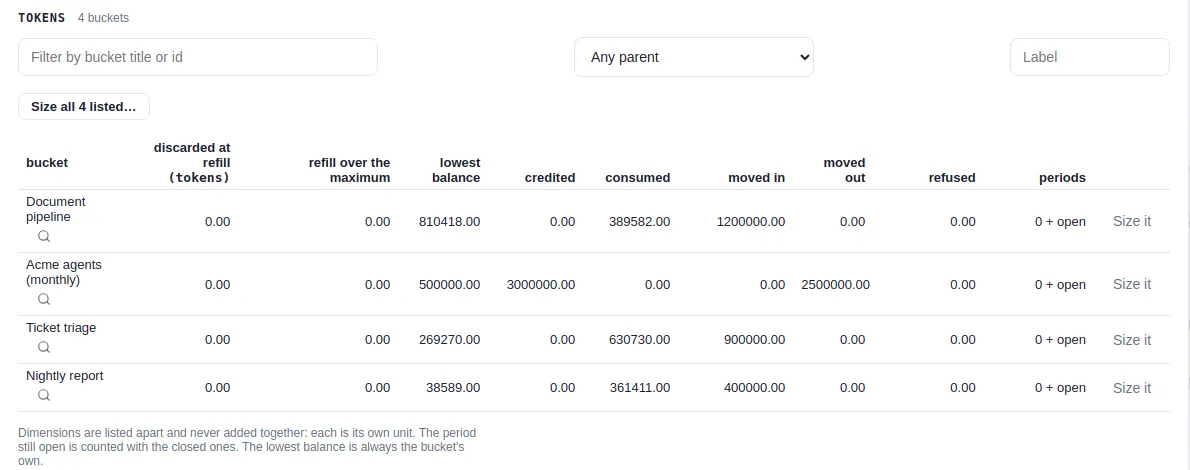
Track each customer’s usage
- A bucket per customer. One call records a use on several dimensions at once, all of it or none of it. An idempotency key makes a retried call count once.
- Usage you can invoice from. The per-period ledger says what each customer used in each period, a breakdown groups usage by any key you put in its metadata, and a CSV export takes it to your billing.
- Allowances and overage. Refill a customer’s allowance on a schedule, credit it after a payment, and, where you allow it, let usage go past the allowance down to a line you set, booked as overage.
- Webhooks. Low balance, depleted, gone into overage: your systems hear of it when it happens.
- Receipts your customers can check. A consumption can carry a receipt signed with your tenant’s key, which your customer verifies on their own, with no access to your systems.
Build reservation systems
- Hold, then commit or release. A reservation holds capacity without spending it. Commit it in full or in part (the rest is released), or release it. A hold that is forgotten expires on its own, and one still in use can be refreshed.
- Concurrency slots. Model “at most five at once” as a dimension, and reserve a slot for each piece of work in flight.
- Commit by a third party. A reservation can come with a commit token that the party doing the work uses to settle it, without your API key.
- Claims across several buckets. Take from all of a set of buckets or none of them, or from the first of them with room, picked in turn.
- Queues with priorities. A claim that cannot be served now can wait in a queue, and waiting claims are served by priority as capacity returns. Claim reservations hold across several buckets the same way.
Try it
Create a tenant in the Console and follow
Getting started. The reservations and
claims help topics on your tenant’s address describe each part.